
 Image 1 of 1
To learn more about print mediums, sizes, and purchasing prints, please visit the Print Info page.
There’s a stigma around "stealing" in photography. With so many cameras out there, it can feel a bit shameful to admit you’re actively trying to reproduce someone else's composition. But doing a true master study—reverse-engineering a piece of art you admire—is one of the most effective ways to actually grow.
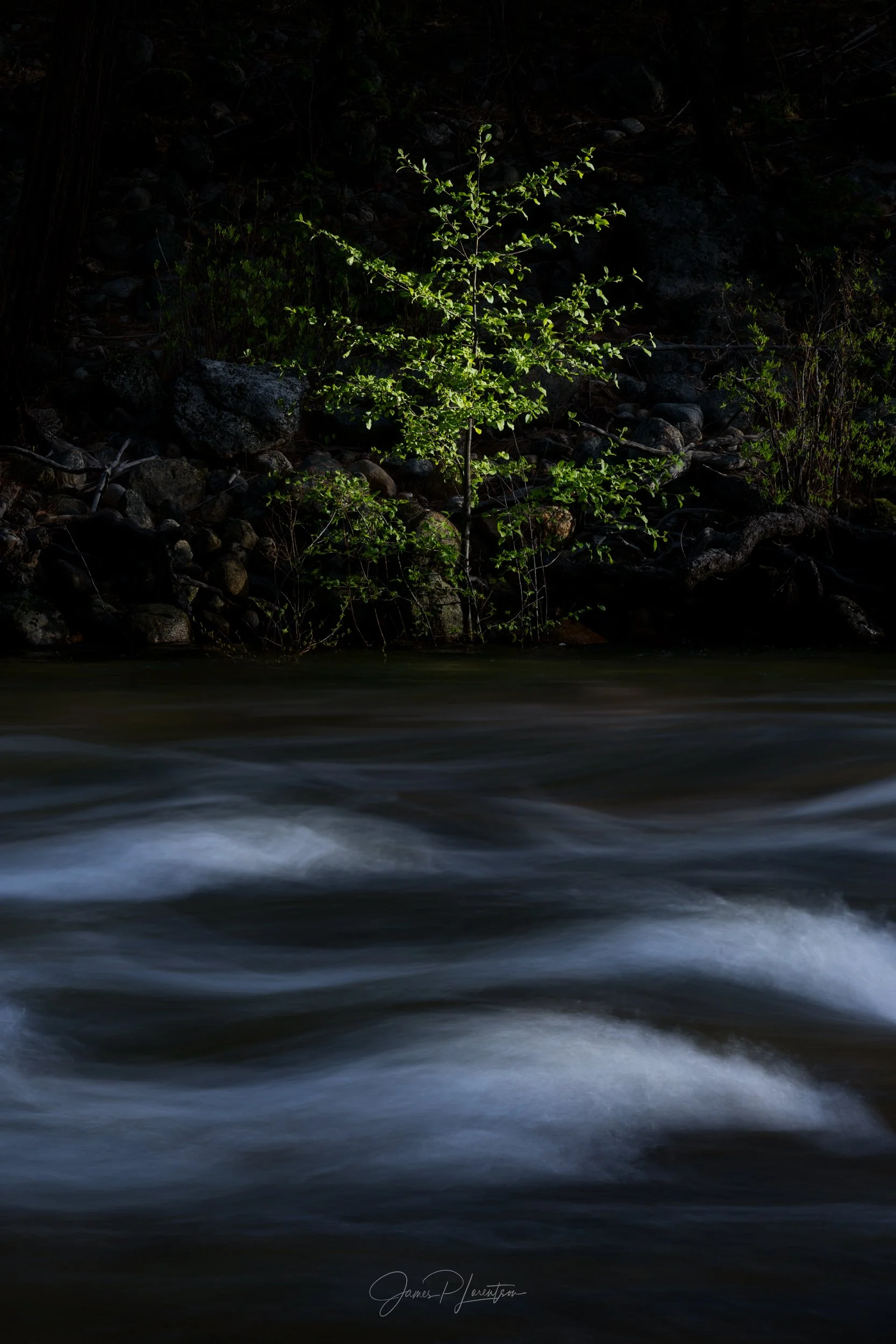
Both of these shots are direct nods to the incredible work of Alex Noriega.
I didn't shoot these to claim them as my own original vision; I shot them to learn how he sees.
Trying to replicate the illuminated sapling (slide 1) forced me to internalize the mechanics in the field. It makes you figure out exactly what camera position, focal length, and shutter speed are required to balance the chaotic flow of the river against the absolute stillness of the glowing leaves.
The black and white waterfall (slide 2) was a lesson in post-processing. When you try to recreate another's image, you start looking at the raw landscape through their editing lens. You realize, "Oh, they absolutely removed that distracting dead tree." Learning that non-impactful elements are removable completely changes how you scout. You stop walking past raw scenes just because of one messy element and start seeing the graphic potential underneath.
You don't want to stay in the copying phase forever. You imitate to extract the techniques, internalize the boundaries, and then take those tools with you to build your own original work. Thanks, Alex.
There’s a stigma around "stealing" in photography. With so many cameras out there, it can feel a bit shameful to admit you’re actively trying to reproduce someone else's composition. But doing a true master study—reverse-engineering a piece of art you admire—is one of the most effective ways to actually grow.
Both of these shots are direct nods to the incredible work of Alex Noriega.
I didn't shoot these to claim them as my own original vision; I shot them to learn how he sees.
Trying to replicate the illuminated sapling (slide 1) forced me to internalize the mechanics in the field. It makes you figure out exactly what camera position, focal length, and shutter speed are required to balance the chaotic flow of the river against the absolute stillness of the glowing leaves.
The black and white waterfall (slide 2) was a lesson in post-processing. When you try to recreate another's image, you start looking at the raw landscape through their editing lens. You realize, "Oh, they absolutely removed that distracting dead tree." Learning that non-impactful elements are removable completely changes how you scout. You stop walking past raw scenes just because of one messy element and start seeing the graphic potential underneath.
You don't want to stay in the copying phase forever. You imitate to extract the techniques, internalize the boundaries, and then take those tools with you to build your own original work. Thanks, Alex.
To learn more about print mediums, sizes, and purchasing prints, please visit the Print Info page.